AngstromCTF 2019 — Secret Sheep Society (AES CBC Bit-Flipping)
AES-CBC bit-flipping attack to forge a session cookie and escalate privileges from regular user to admin.
A classic AES-CBC bit-flipping attack used to forge admin session tokens.
Challenge Details
Category: Crypto | Points: 120 | Solves: 98
TL;DR
- Identify the AES-CBC session structure
- Obtain a valid token with a crafted handle
- Flip specific bits in the IV to change
false→truein the admin field - Send the forged token to get the flag
Understanding the Application
Three routes:
/— shows flag ifadmin: truein session/enter— acceptshandle, createstoken = base64(IV + AES_CBC(session_json))/exit— clears the token cookie
The session JSON format:
{"admin": false, "handle": "xx"}The pack() method:
def pack(self, session):
    cipher = AES.new(self.key, AES.MODE_CBC)
    iv = cipher.iv
    dec = json.dumps(session).encode()
    enc = cipher.encrypt(pad(dec, self.BLOCK_SIZE))
    return base64.b64encode(iv + enc)
Key observation: the IV is the first 16 bytes of the base64-decoded token — and it’s not encrypted.
The Attack
AES-CBC decryption scheme — flipping a bit in the IV flips the same bit in the first plaintext block:

With handle = "xx", the plaintext is exactly 32 bytes (2 blocks):
Block 0: {"admin": false,
Block 1:  "handle": "xx"}
In AES-CBC decryption:
P[0] = AES_DEC(C[0]) XOR IVSo flipping a bit in the IV flips the corresponding bit in P[0].
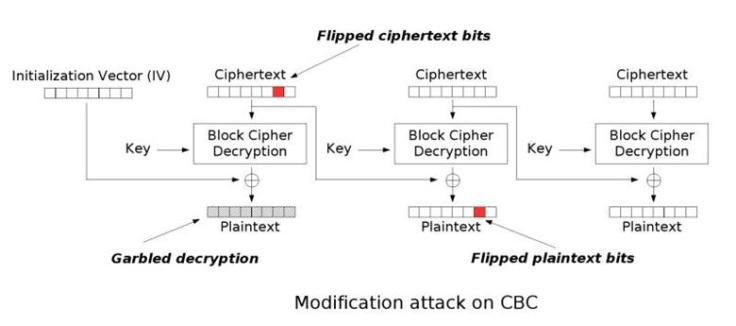
We want to change false (offset 10-14 in block 0) to true (with trailing space):
| Offset | Original | Target |
|---|---|---|
| 10 | f | t |
| 11 | a | r |
| 12 | l | u |
| 13 | s | e |
| 14 | e | |
Full Exploit
import requests
from base64 import b64encode, b64decode
import re

URL = "https://secretsheepsociety.2019.chall.actf.co/"
session = requests.Session()
token_exp = re.compile(r'token=(.*);')

# Step 1: Get a token with handle="xx"
req = session.post(URL + "enter", data={"handle": "xx"},
                   verify=False, allow_redirects=False)
token = None
if req.status_code == 302:
    m = re.search(token_exp, req.headers["Set-Cookie"])
    if m:
        token = m.group(1)
        print(f"[+] Token: {token}")

# Step 2: Flip bits in the IV to change false → true
if token:
    ct = list(b64decode(token))
    flips = [(10, 'f', 't'), (11, 'a', 'r'), (12, 'l', 'u'),
             (13, 's', 'e'), (14, 'e', ' ')]
    for offset, orig, target in flips:
        ct[offset] ^= ord(orig) ^ ord(target)
    forged_token = b64encode(bytes(ct)).decode()
    print(f"[+] Forged token: {forged_token}")

# Step 3: Use forged token to get the flag
session2 = requests.Session()
req2 = session2.get(URL, cookies={"token": forged_token})
flag_m = re.search(r'actf\{.*?\}', req2.text)
if flag_m:
    print(f"[+] FLAG: {flag_m.group(0)}")
Flag: actf{shep_the_conqueror_slumbers}
Why It Works
In CBC mode decryption:
P[i] = AES_DEC(C[i]) XOR C[i-1]For block 0, C[-1] is the IV. By XOR-ing IV[j] with orig XOR target, we flip exactly the right bit in the plaintext without affecting other blocks. The ciphertext block itself becomes garbled, but since we only care about block 0, that’s acceptable.
Mitigation
- Use authenticated encryption (AES-GCM or AES-CCM) instead of CBC — it detects tampering
- Sign session cookies with HMAC in addition to encrypting them
- Never place sensitive boolean flags where they can be bit-flipped